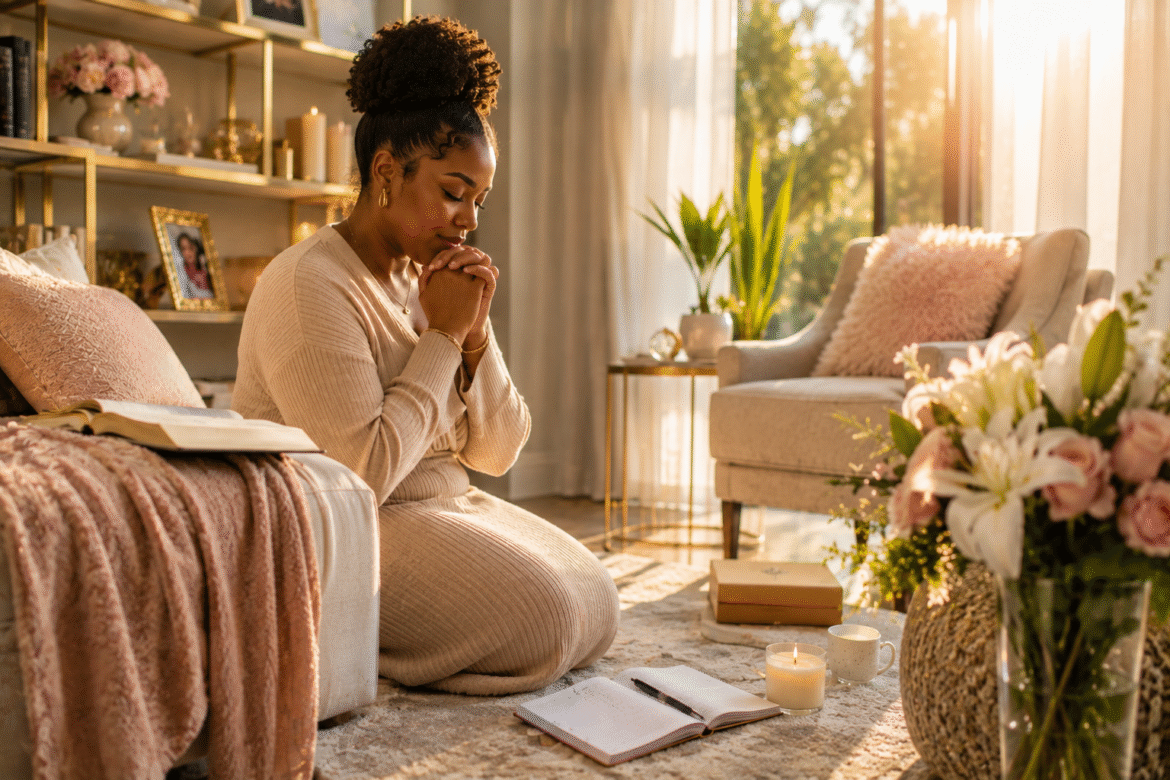
A beautiful house and a peaceful home are not necessarily the same thing. You can have beautiful furniture, carefully chosen décor, scented candles in every room, a television large enough to make the neighbours feel involved, and decorative cushions that apparently exist only to be looked at because nobody is actually allowed to sit on them, yet still live in an atmosphere filled with tension.
And someone else can live very simply, without anything particularly impressive about the building, yet when you enter, something feels different. There is peace. There is kindness. There is rest. The question today is not how impressive the place where you live looks. The deeper question is: What is filling its atmosphere? David writes:
“He that dwelleth in the secret place of the most High shall abide under the shadow of the Almighty.” — Psalm 91:1 KJV
For twenty-four mornings we have been returning to the secret place. But eventually something must happen: what God is doing in the secret place must begin following us into ordinary life.
Before We Talk About The House, Let Us Talk About The Dweller
Psalm 91:1 is not primarily a verse about physical houses. Its beautiful picture is of a person dwelling in God. That distinction matters. We can put Christian objects around a house without cultivating communion with God. A Bible on the coffee table is wonderful, but its physical location cannot transform the atmosphere while it remains permanently closed.
A framed Scripture on the wall can remind us of truth, but the frame itself cannot obey the verse. The woman who dwells in the secret place becomes a carrier of what she encounters there. That means perhaps the first prayer for our homes should not be: “Lord, change this atmosphere.” Perhaps it should begin: “Lord, change me.” Because I am part of the atmosphere. My words contribute to it. My attitude contributes to it. My reactions contribute to it. My habits contribute to it. The way I treat people contributes to it. Prayer becomes powerful when we stop seeing ourselves only as observers of an atmosphere and recognize that we are also participants in creating one.
“Dwelleth” Is Different From “Visiteth”
Psalm 91 says: “He that dwelleth…” There is permanence in that word. A visitor arrives and leaves. A dweller remains. The goal of Prayer Awakening was never to give God thirty interesting mornings in September and then return to normal life. We are learning to dwell. And dwelling with God should eventually influence what happens after prayer ends.
It is possible to pray powerfully at 5:00 AM and become a completely different person at 7:15 AM because somebody used our favourite mug. That is when the secret place needs to follow us into the kitchen. Communion with God is not meant to remain confined to the moment when our eyes are closed.
It should influence how we speak when irritated, how we respond to disagreement, how quickly we forgive, how we make decisions and how we treat people when nobody is calling the moment “spiritual.” I don’t want God’s presence to be something I recognize only during worship and prayer. I want communion with Him to influence the way I speak, rest, make decisions and treat people when nobody is calling the moment spiritual.
God’S Presence Is Not A Playlist
Worship music in a home can be beautiful. Scripture playing in the background can help create opportunities to meditate upon God’s Word. Prayer within a home matters greatly. But we should never confuse the symbols of a spiritual atmosphere with the substance of one. God’s presence is not a playlist. You can have worship music playing loudly while two people are refusing to forgive each other.
At that point, the speakers are doing their best, but they cannot obey Scripture for us. Colossians says:
“And let the peace of God rule in your hearts…” — Colossians 3:15 KJV
Notice that peace is supposed to rule. God’s peace should have authority over the way we respond. A home that honours God is cultivated through truth, righteousness, love, forgiveness, wisdom, prayer and the everyday treatment of people.
Peace Does Not Mean Nobody Ever Disagrees
A peaceful home is not a home where everybody has identical opinions. People disagree. Relatives misunderstand each other. Friends sharing a space can irritate one another. Roommates discover that apparently there are seventeen different correct ways to wash a plate. People become tired. Someone speaks too quickly. Another person misunderstands. The presence of disagreement does not automatically mean the absence of God’s presence.
The real question is: What governs us when disagreement comes? Proverbs says:
“A soft answer turneth away wrath: but grievous words stir up anger.” — Proverbs 15:1 KJV
Sometimes we pray: “Lord, bring peace into this house!” And the Holy Spirit may gently deal with the tone we have been using. Not every atmosphere needs to be rebuked. Some atmospheres need an apology. Sometimes the most spiritual sentence spoken in a home is simply: “I was wrong. Please forgive me.” That can change an atmosphere remarkably quickly.
Your Home Matters Even If You Live Alone
If you live alone, this prayer is completely yours. Your home does not become less significant because only one person lives there. It can become a place where your soul rests. A place where Scripture is loved. A place where prayer grows. A place where wise decisions are made. A place where healthy habits are cultivated. A place where people can eventually receive hospitality and leave strengthened.
You can also become intentional about what enters your environment through media, conversations and habits. The presence of God is not dependent upon how many people share your address. One woman dwelling with God can cultivate a life in which her home becomes an extension of her secret place. WHAT IF YOU DO NOT CONTROL YOUR HOME ENVIRONMENT? This is important because not every woman has authority over everything happening where she lives.
Perhaps you live with relatives who do not share your faith. Perhaps there are difficult relationships. Perhaps you share accommodation. Maybe the home environment is complicated, and some circumstances are beyond your immediate control. We should never suggest that every difficult household exists because somebody did not pray enough. Scripture itself recognizes relational limitations. Paul writes:
“If it be possible, as much as lieth in you, live peaceably with all men.” — Romans 12:18 KJV
Notice: “If it be possible.” And: “As much as lieth in you.” You cannot control every person’s choices. You cannot force everybody around you to become peaceful. But you can ask God for wisdom concerning how you live. You can refuse to feed unnecessary conflict. You can establish wise boundaries where necessary. You can pray. You can remain truthful. You can guard your own communion with God. And you can trust Him with what remains beyond your control.
Invite God Into Ordinary Life
Homes are where remarkably ordinary things happen, yet those ordinary things shape lives. People eat. Rest. Study. Work. Plan businesses. Discuss finances. Make decisions. Recover from difficult days. Have conversations that can strengthen or wound relationships. Some people cry privately in rooms nobody else enters. Others dream about futures that have not yet become visible. A God-honouring home is not merely somewhere prayer meetings happen. It is somewhere God is welcomed into ordinary life. Luke 10 tells us that Jesus entered the home of Martha and Mary. Martha became occupied with serving while Mary sat at Jesus’ feet.
The lesson is not that serving or household responsibilities are unspiritual. The danger was becoming so “cumbered about much serving” that the presence of Jesus was overshadowed by the pressure of everything that needed to be done. Homes can become busy places. There is always something requiring attention. But we must never become so busy managing life that we forget the One who gives life meaning.
Let The Altar Touch The Atmosphere
Today, think about the place where you live. Not fearfully. Not superstitiously. Prayer is not about turning every doorway and piece of furniture into a spiritual mystery. Simply bring your home before God. Ask Him to let peace govern there. Ask for wisdom in relationships. If there is unresolved conflict, ask for grace and direction. If someone needs salvation, carry them before God. If there is pain, ask for healing and restoration. If you live alone, ask God to make your space a place where your relationship with Him flourishes.
Then ask an even more personal question: “Lord, what can change in me that will make this home more reflective of You?” Perhaps it is your tone. Perhaps forgiveness. Perhaps a habit. Perhaps what you allow through your screen. Perhaps how you respond when tired. Perhaps your prayer life simply needs to continue beyond September. Yesterday we prayed for the next generation. Today we pray for the environments in which generations, friendships, relationships, dreams and everyday lives are being shaped.
May our homes become places where God is honoured. Not because worship music is always playing. Not because Scripture is written on every wall. But because the people dwelling there can increasingly see the fruit of someone who has learned to dwell in the secret place of the Most High.
Declarations
◆ I choose to dwell in the secret place of the Most High and allow communion with God to shape my everyday life.
◆ The peace of God will increasingly govern my heart, my words and the atmosphere I contribute to where I live.
◆ I receive wisdom to speak with grace, respond with patience and seek reconciliation wherever it is right and possible.
◆ I refuse to pray for a peaceful atmosphere while continually contributing unnecessary conflict through my own words or behaviour.
◆ My home will increasingly become a place where truth, righteousness, wisdom, love, forgiveness and prayer are honoured.
◆ Whether I live alone or with others, the place where I live can become an environment in which my relationship with God flourishes.
◆ I receive grace for difficult household circumstances and wisdom concerning what I can change, what requires boundaries and what I must entrust to God.
◆ I invite God into the ordinary parts of my life, including my decisions, conversations, work, rest, relationships and plans.
◆ What God is awakening in my secret place will increasingly become visible in the way I live when prayer time has ended.
◆ By God’s grace, I will become a carrier of His peace and presence wherever He has placed me.
My Prayer For You
May God meet you in the place you call home, whether it is peaceful, complicated, full, quiet, temporary or permanent. May His wisdom govern you, His peace fill your heart, and may what He is awakening in your secret place increasingly touch the atmosphere around you.